 March 23, 2026
 Monday Motivation
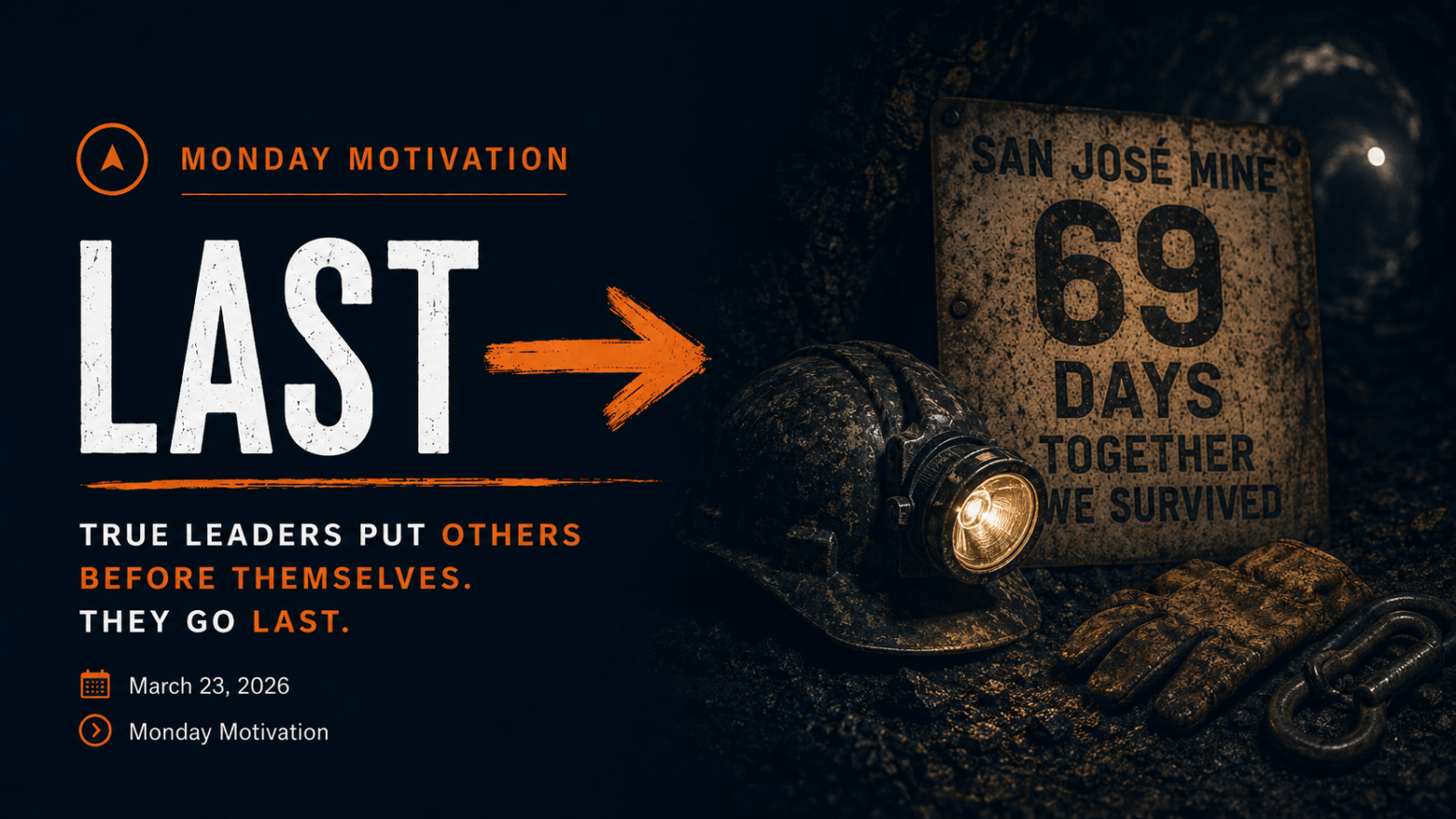
On August 5, 2010, in the remote Atacama Desert of northern Chile, 33 miners were working deep inside the San José mine when a massive collapse shook the tunnels. Within moments, rock and debris sealed off their main access route, trapping them about 2,300 feet below the surface. Dust filled the air as darkness took over and the reality began to set in that they were trapped and there was no clear way out. Above ground, rescuers did not know if anyone had survived. Below ground, the miners faced extreme heat, suffocating conditions, and uncertainty. What they knew was that they had limited supplies. What they did not know was if help would come in hours, days, or not at all. How could they survive? Their survival depended on something greater than tools or technology. It depended on leadership and teamwork.
Instead of panicking, the miners organized themselves. They created a structured system where each person had a clear role. Some rationed food and water. Others cared for injuries and health concerns. Some worked to maintain morale and hope, while others managed daily routines and organization. Because each miner had a responsibility, they gained a sense of purpose and stability. By working together, they preserved their resources, avoided chaos, and stayed mentally strong.
They remained trapped for 69 days.
Their survival was guided by their leader, Luis Urzúa. As the foreman, he stepped into leadership immediately after the collapse. He encouraged cooperation, maintained order, and gave the group hope. He made sure decisions were fair and that no one was overlooked.
When rescue finally came, it took about 22 hours to bring the miners to the surface. One by one, they were lifted to safety. Urzúa had the opportunity to go first, but he refused. Instead, he stayed behind and made sure every miner was safely rescued before him. Only after the last man had reached the surface did he enter the capsule. He chose to go last.
Because of that decision, Urzúa not only endured the same 69 days underground as the others, but he also remained below longer than anyone else.
This moment reveals an important truth. Leadership is not about privilege. It is about responsibility. A leader’s role is not to be served, but to serve others and protect the team.
True leaders put others before themselves. They eat last because others must be fed first. They get paid last because the team’s needs come first. They take responsibility when things go wrong and accept recognition only after others are acknowledged. They stay until the work is done and the people are safe.
There is a difference between being in charge and being a leader. Authority can be given, but leadership is earned through trust. When leaders put themselves first, trust breaks down. When they focus only on their own needs, resentment grows. But when leaders go last, people feel supported. Trust increases, and teams become stronger and more united.
Going last is not a sign of weakness. It is a sign of strength and discipline. It reflects a mindset that says, “My role is to serve, not to be served.” Strong leaders are secure enough in who they are that they do not need to be first.
As it is written, “So the last will be first, and the first last” (Matthew 20:16, ESV).
This week, choose to put others first, even if it means going last.
Practical reflections for pastors and leaders who want to build healthier people, ministries, and organizations.
Explore all Articles →

Short, practical reflections every Monday to help leaders think clearly, lead faithfully, and live with character.
View all Monday Motivation →Invite Dan to speak, coach, or consult with your organization.
Contact Dan