 July 27, 2026
 Monday Motivation
Some of the hardest decisions we ever make don’t come when we’re facing our enemies. They come when we’re sitting beside our friends.
Those decisions are made in conference rooms, committee meetings, boardrooms, classrooms, and around dinner tables. They’re made among people we respect, people we like, and people whose approval we value. That’s what makes them so difficult.
It’s one thing to stand against someone who opposes you. It’s another thing entirely to stand against those with whom you love and respect.
Yet there are moments when doing the right thing requires exactly that, to stand alone and say, “that is not right.”
It usually begins slowly with a decision that doesn’t match your conscience. Everyone seemed to have reached a consensus, and then they look at you. In that moment, the easiest thing to say is, “I agree.” Not because you believe it, but because you don’t want to be the lone voice. You justify it by saying “well, they must be right, because I respect them,” but deep down you know they are wrong.
Group pressure is powerful. We don’t like to disappoint people. We don’t want to be labeled difficult. Sometimes we’re afraid that by speaking up it will cost us friendships or opportunities in the future. Sometimes we are afraid speaking up will cause conflict, so we remain silent. Or worse, we go along with a decision we know is wrong.
Silence has a way of becoming agreement. Agreement has a way of becoming responsibility. When we remain silent, our silence is interpreted as consent. Once that happens, we become responsible for what follows.
Real leaders should not be measured by how well they echo the majority. It is measured by their willingness to speak when their conscience tells them that something is wrong.
That doesn’t mean being argumentative or difficult. It doesn’t mean believing you’re always right. It simply means having the courage to respectfully say, “I can’t support this,” or “I believe we’re making a mistake.”
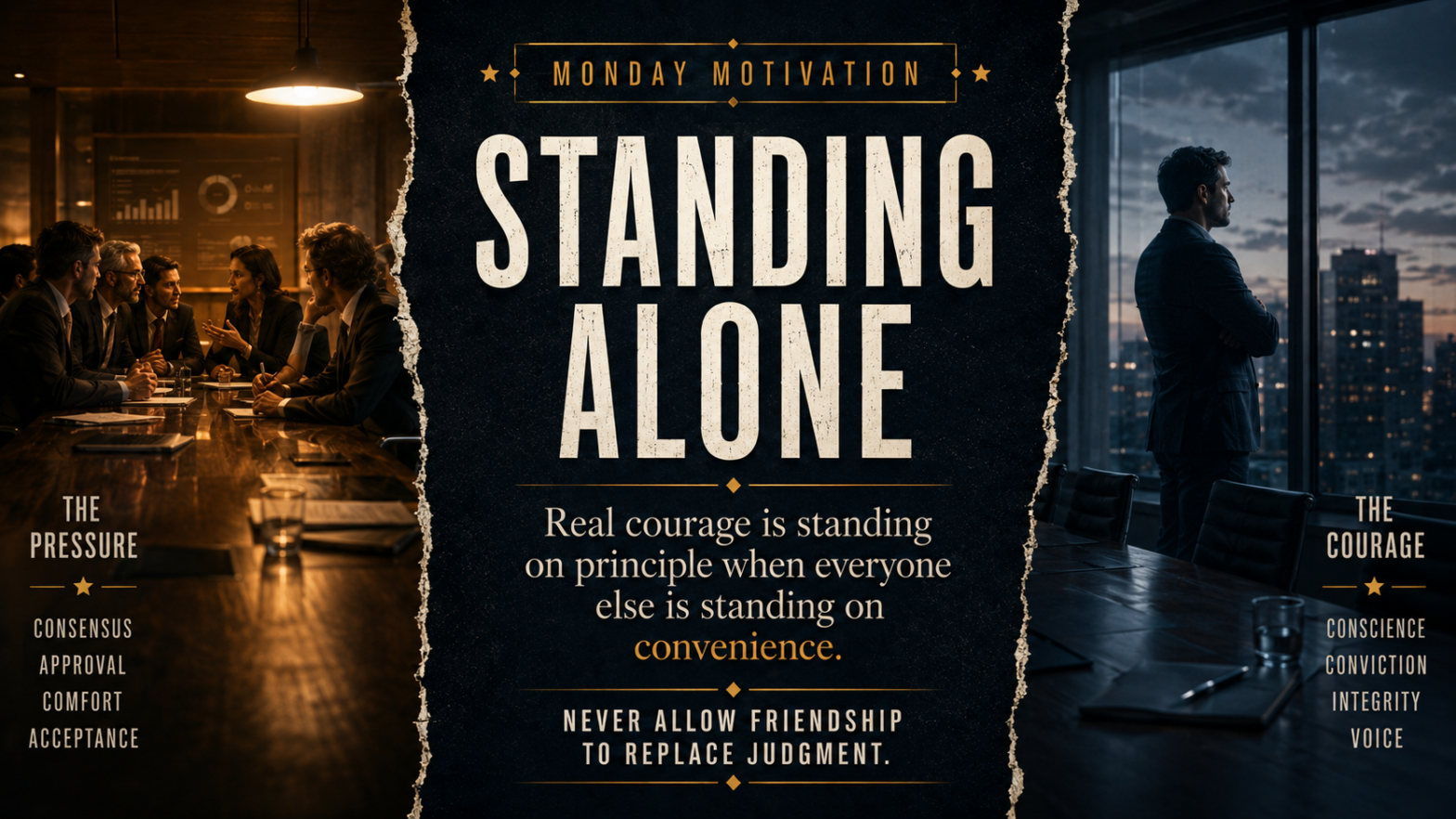
Real courage isn’t loud. Real courage is being calm enough to stand on principle when everyone else is standing on convenience.
One thoughtful voice can change the course of a conversation and the decision.
Never allow friendship to replace judgment.
Never allow intimidation to silence conviction.
Never allow the desire to be accepted to outweigh the responsibility to do what is right.
Ed Catmull, co-founder of Pixar, showed that organizations thrive when people feel safe to say, “I think we’re wrong.” In his book “Creativity, Inc.”, Catmull argues that disagreement is essential because: “People are more important than ideas.”
He stated good teams can improve weak ideas, but only if people feel free to point out problems. He said, “If everyone is agreeing too quickly, there’s a good chance important information is being left unsaid.”
During the production of Toy Story 2, everyone believed the story was great until a handful of people spoke up and said it wasn’t. Their willingness to speak out led to the entire story being rewritten. The team didn’t care about the loss of money, loss of time or making people upset, they simply wanted the best story and spoke up. They could have just gone along with the majority but instead spoke their beliefs.
This week, if you find yourself in a meeting where the easy choice is to simply nod, pause before you do. Ask yourself one question:
“If I say nothing today, will I be proud of my silence tomorrow?”
If the answer is no, then speak. Please do it kindly and respectfully but speak. There are moments when the most important voice in the room isn’t the majority’s.
It’s yours.
Practical reflections for pastors and leaders who want to build healthier people, ministries, and organizations.
Explore all Articles →

Short, practical reflections every Monday to help leaders think clearly, lead faithfully, and live with character.
View all Monday Motivation →Invite Dan to speak, coach, or consult with your organization.
Contact Dan