 September 14, 2026
 Monday Motivation
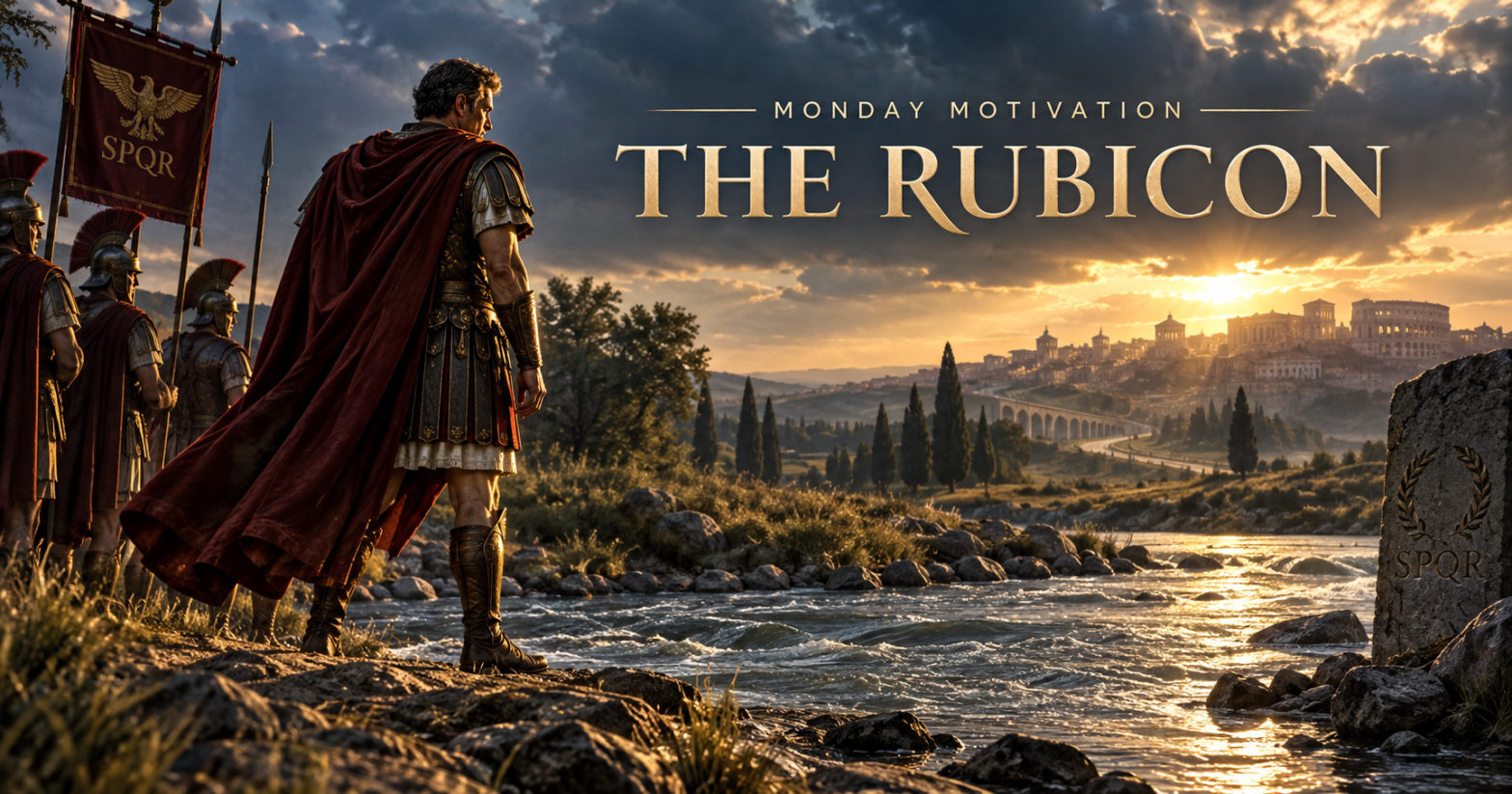
In 49 B.C., Julius Caesar stood at the edge of a small river in northern Italy called the Rubicon. Caesar was one of Rome’s greatest generals, returning after years of conquering Gaul. His soldiers had marched with him, suffered with him, bled with him, and watched him win battles others said could not be won. They would have followed him anywhere.
Now Caesar was leading those soldiers toward Rome when he stopped. Not because an enemy stood in his way. Not because of a fortress. Not because of a mountain range. He stopped because of a river. It wasn’t a mighty river like the Nile; it was a small river which his soldiers could have crossed easily.
So why did Caesar stop?
Because Rome had drawn a line. A Roman general could command his army outside Italy, but he could not cross that boundary with his troops while retaining military command. To cross the Rubicon with his army was an act of treason. So, Caesar stood on the bank facing a choice. He could turn back and keep his options open, or he could cross the river knowing there would be no turning back.
As long as Caesar remained on that side of the river, he could negotiate. He could delay. He could make another plan. He could even change his mind. But once he crossed, everything would change.
Caesar crossed.
More than two thousand years later, we still speak of “crossing the Rubicon” when someone makes a decisive commitment from which there is no easy return. The Rubicon has become more than the name of a river. It represents the line between considering and committing, between thinking about what you are going to do and actually doing it.
All of us will have Rubicon moments in our lives. These are moments when one decision means you are not simply deciding what you will do next. You are deciding who you will become next.
Most of the time life changes gradually. But sometimes a life changes in a moment. It changes when someone finally says, “I have had enough.” It changes when someone says, “I am not living this way anymore.” It changes when someone says, “I am going to move forward.” It changes when someone stops hoping things will be different and makes the decision to make them different.
That is the power of a Rubicon decision.
Once you decide what matters, certain distractions lose their authority. Once you decide who you are going to become, certain habits no longer fit. Once you decide where you are going, some roads are no longer yours to travel. There is clarity in Rubicon decisions.
A real decision settles questions you no longer need to keep asking.
The problem most people face is not that they do not have a Rubicon. The problem is that they spend too much of their lives standing on the bank staring at it.
They know the decision they need to make or the conversation they need to have. They know what needs to change and where they need to begin. But instead of taking that first step, they wait.
They wait because the decision is hard. There are consequences. They might make the wrong choice, disappoint someone, or end up somewhere they didn’t expect. So they wait, hoping for more clarity or a little more certainty. Keeping their options open feels safer than choosing. But keeping your options open has a cost
There is a cost to making a decision. But there is also a cost to not making one.
You can spend a lot of time thinking about what might happen if you act, but very little time thinking about what might happen if you don’t. We calculate the risk of moving forward but rarely calculate the risk of standing still.
What will it cost you to wait another year? What opportunity disappears? What relationships will you forfeit? What happens to your character when you keep choosing what is comfortable over what you know is right?
Sometimes the most expensive decision you ever make is the decision you refuse to make. There comes a time when you must decide.
You may not have all the answers. Caesar did not know everything that would happen after he crossed that river. Neither will you. There are decisions in life where you will never have enough information to remove every doubt. But at some point, you must take what you know, listen to wise counsel, examine your heart, consider the consequences, pray, and make the best decision you can.
Then move.
Why? Every Rubicon requires a decision, and decisions do not just change our circumstances. They change us.
Sometimes the greatest thing on the other side of the Rubicon is not the opportunity waiting for you. It is the person you become by crossing it.
So what is your Rubicon? Maybe this is the week to stop staring at the river and just cross it.
Practical reflections for pastors and leaders who want to build healthier people, ministries, and organizations.
Explore all Articles →

Short, practical reflections every Monday to help leaders think clearly, lead faithfully, and live with character.
View all Monday Motivation →Invite Dan to speak, coach, or consult with your organization.
Contact Dan