 June 16, 2026
 Monday Motivation
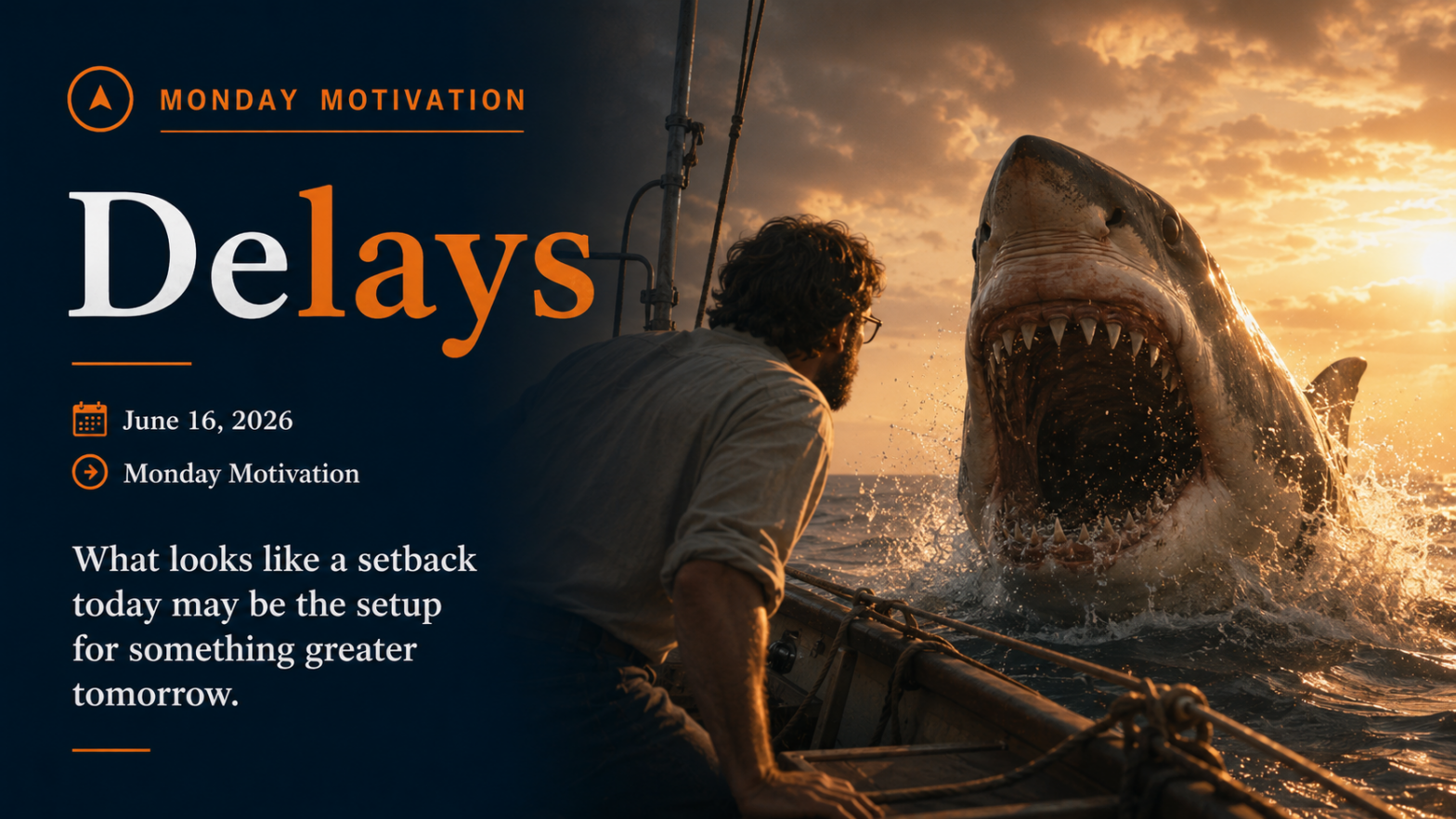
In 1974, 27-year-old Steven Spielberg took on the challenge of directing Jaws, a film adaptation of Peter Benchley’s bestselling novel about a great white shark terrorizing a small island community. Although Spielberg was young and had only one theatrical feature film to his credit, he possessed a clear vision for what he wanted the movie to be.
From the beginning, he knew exactly how he wanted the film to open. He described to the producers a scene in which a young woman swimming alone at night is suddenly attacked by a shark. His goal was simple: he wanted the entire audience to jump out of their seats. To make the movie feel real, Spielberg insisted on filming in the ocean and planned to use a full-size mechanical shark rather than footage of a real one.
To build the shark, the producers hired 64-year-old Robert Mattey, the special effects expert who created the giant squid for 20,000 Leagues Under the Sea. Mattey came out of retirement and built three mechanical sharks. Nicknamed “Bruce” after Spielberg’s lawyer, the sharks impressed everyone who saw them.
Spielberg believed the shark would be the star of the movie. There was only one problem.
It didn’t work.
What no one expected was that the mechanical shark had a serious flaw. It worked perfectly in testing tanks, but once placed in the Atlantic Ocean, the saltwater corroded its gears and damaged its paint. The shark constantly malfunctioned.
While technicians struggled to repair it, Spielberg continued filming scenes that did not require the creature. But production quickly fell behind schedule. Costs soared. Frustration grew. Executives began wondering whether the young director was in over his head. The original schedule called for a 55-day shoot, yet 90 days into filming there was still no reliable shark ready for filming.
How do you make a shark movie without a shark?
Necessity forced creativity.
One night, Spielberg came up with a new idea. Instead of showing the shark, he would show only its effects: rippling water, frightened reactions, and sudden attacks. The audience would never see the danger directly. They would simply know that something terrifying was lurking beneath the surface.
The idea worked.
Because the shark remained unreliable, Spielberg had little choice but to keep it hidden for much of the movie. In fact, viewers do not get a clear look at the shark until more than an hour into the film. By the time the mechanical shark was finally working, Spielberg had already built much of the movie around suspense rather than special effects.
When Jaws was released, critics praised what they believed was Spielberg’s artistic restraint. They admired the tension he created by not showing the shark. The unseen threat forced audiences to imagine something even scarier than any mechanical shark could have delivered. What began as a production disaster became one of the film’s greatest strengths.
Jaws went on to become the first summer blockbuster. Produced on an original budget of $3.5 million, the film ultimately cost around $9 million to make. It would go on to gross roughly $476 million worldwide and become one of the most influential movies in cinematic history.
Ironically, the very obstacle that seemed capable of destroying the film became one of the primary reasons it succeeded. What Spielberg viewed as a crisis became the catalyst for greatness.
Life often works the same way.
Our delays and detours may be preparing us for our greatest victories.
When our plans are disrupted, we often assume something has gone wrong. We become frustrated when opportunities do not come when we expect them, when doors close unexpectedly, or when circumstances force us to change direction. We focus on the inconvenience instead of considering that something better may be developing behind the scenes.
Yet many of life’s greatest breakthroughs arrive disguised as setbacks.
The job we didn’t get may lead to a better career. The relationship that ended may create room for one that is healthier and stronger. The business idea that stalls may expose weaknesses that would have caused greater trouble later. What appears to be a delay may actually be preparation.
That does not mean disappointments feel good in the moment. Spielberg certainly was not celebrating while production dragged on and expenses mounted. Delays are stressful. Problems are discouraging. Uncertainty is uncomfortable.
But the lesson of Jaws is that today’s obstacle may become tomorrow’s advantage.
We rarely know in the moment whether a setback is truly a setback. Sometimes what we call bad timing is actually God’s perfect timing working in ways we cannot yet understand. Sometimes the detour leads to a better destination than the road we originally planned to take.
So when things do not go according to plan, resist the urge to panic. Do not assume that a closed door marks the end of your journey. Instead, remain patient. Stay flexible. Keep moving forward.
The mechanical shark that nearly ruined Jaws ended up helping create one of the greatest films ever made. What looked like a problem became part of the solution.
The very thing we curse today may be the thing we thank God for tomorrow. One day, we may discover that what seemed to be holding us back was quietly preparing us for where we were meant to go.
Maybe the question is not, “Why is this happening to me?” but, “What is this preparing me for?”
One day, we may look back and realize that what seemed to be holding us back was actually moving us toward something better.
Practical reflections for pastors and leaders who want to build healthier people, ministries, and organizations.
Explore all Articles →

Short, practical reflections every Monday to help leaders think clearly, lead faithfully, and live with character.
View all Monday Motivation →Invite Dan to speak, coach, or consult with your organization.
Contact Dan