 June 1, 2026
 Monday Motivation
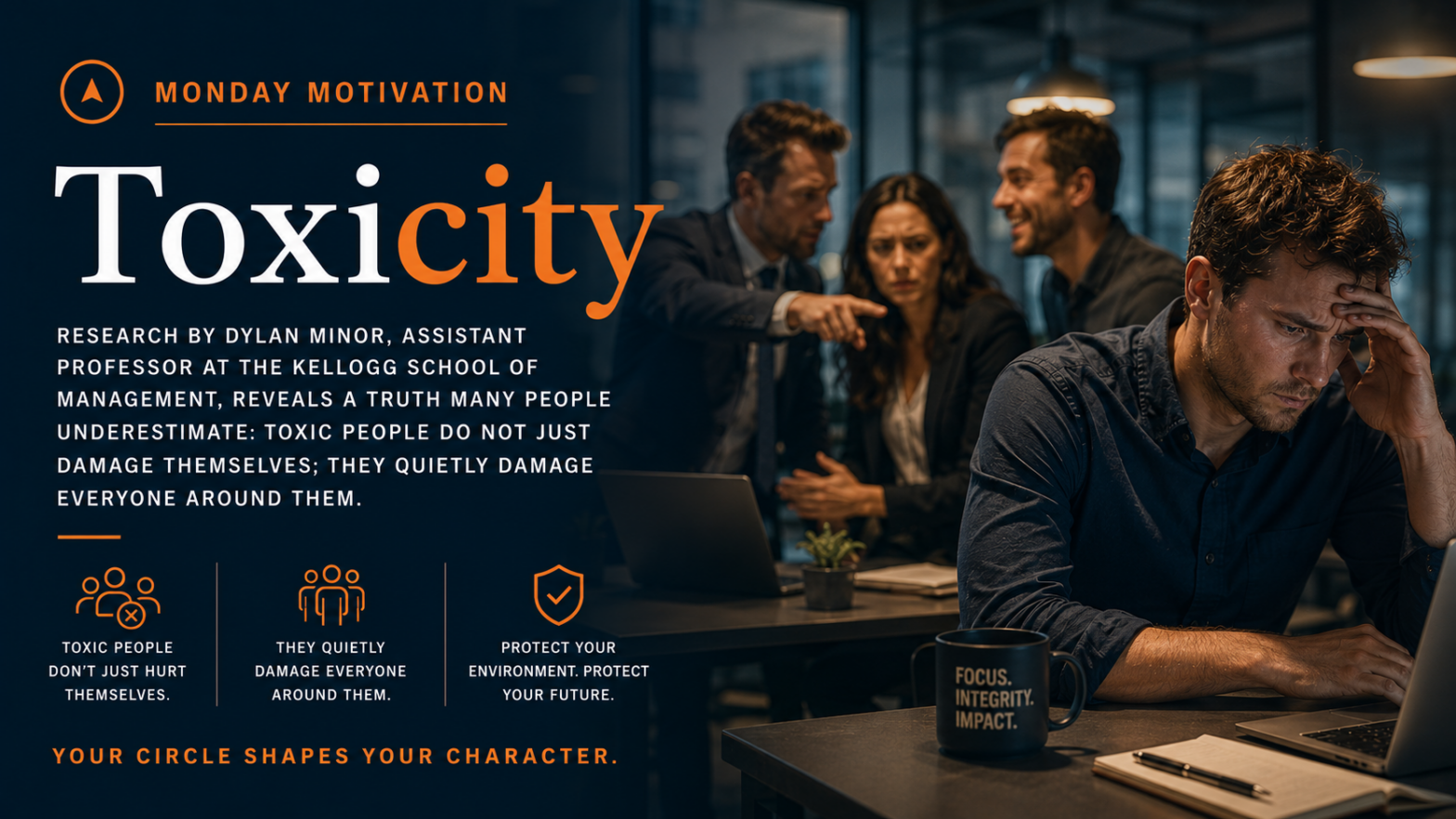
Research by Dylan Minor, assistant professor at the Kellogg School of Management, reveals a truth many people underestimate: toxic people do not just damage themselves; they quietly damage everyone around them.
In a major study involving 58,000 employees at leading technology companies, researchers discovered that the people closest to you influence your behavior far more than you realize. Employees sitting within just a 25-foot radius of either a high performer or a toxic coworker began reflecting the attitudes and behaviors around them. High performers improved productivity by 15%. But toxic individuals caused nearly double the impact in the opposite direction, creating a 30% decline in performance, morale, trust, and ethical behavior.
Even more alarming, employees who worked closely with toxic people became 47% more likely to develop toxic behaviors themselves.
That is the frightening power of influence.
Negativity spreads faster than positivity. Attitudes are contagious. Character is contagious. Energy is contagious. What surrounds you eventually begins shaping you.
Minor notes that the danger is that toxic people are not always obvious failures. Many appear confident, successful, ambitious, charismatic, and productive. They may speak well, rise quickly, and look impressive on the surface. But underneath their appearance, they leave destruction behind them. Toxic people often weaken trust, spread fear, create division, damage relationships, lower standards, and slowly poison the culture around them.
His conclusion? Removing one toxic employee creates greater long-term value than hiring a superstar performer.
Why?
Because toxicity infects everyone nearby.
What begins as exposure eventually becomes imitation.
One of the greatest dangers in life is not simply being hurt by toxic people but slowly becoming like them without realizing it. Constant exposure normalizes negativity, arrogance, manipulation, selfishness, dishonesty, and compromise. Little by little, your standards shift. Your mindset changes. Your heart hardens. What once bothered you becomes acceptable simply because you see it every day.
The bottom line is this: the people around you are shaping your thinking, your habits, your integrity, and ultimately your future.
Because toxicity often wears a mask externally, you must guard your environment carefully.
You may not be able to choose who you work with, but you can choose your friends, mentors, and other relationships wisely. Choose wisely the voices you allow into your life because the people closest to you are always influencing who you are becoming.
But there is something else this study revealed: influence works both ways.
Just as others are influencing you, you are influencing others every single day.
Your attitude enters every room before your words do. Your presence either brings peace or tension, encouragement or discouragement, honesty or compromise. The energy you carry affects people more than you think.
You never know whose strength may rise because of your example.
You never know whose hope may return because of your kindness.
You never know whose character may improve because of your influence.
So do not become careless with others.
Protect your character.
Protect your mind.
Protect your environment.
And refuse to allow toxic people to slowly shape you into someone you were never meant to become.
Because what surrounds you today will shape who you become tomorrow.
And while others are influencing your life, never forget: your presence is quietly influencing theirs as well.
During a soccer match in 2012, Klose scored a goal using his hand but the referee did not see the foul. The crowd celebrated and his team thought they had won an advantage. Most players would have stayed silent and accepted the goal. But Klose did not. He walked straight to the referee and told the truth. The goal was canceled and his team eventually lost the game. Klose lost the game but gained something far greater than a victory. He earned respect from the entire world.
The referee instantly believed Klose because he had spent years building a reputation for integrity. His teammates were not angry with him because they knew his honesty was stronger than the pressure to win, and they respected him. Even today, as a coach, people still trust him because of the character he showed throughout his life. With Klose, there are no surprises and no wondering whether he is hiding something. You simply get the truth. When you walk in truth, you walk away with trust.
Trust is never given to you. It is earned. Many psychologists say it takes two years to build trust with someone. Hard work, honesty, and consistency through the years develops trust with others. But trust is fragile. One selfish decision, one lie, or one careless action can destroy what took a lifetime to build.
Therefore, every decision we make matters. One writer said it best: our decisions are currency. Every choice we make is either a deposit or a withdrawal in the bank of trust. The way we speak to people, the promises we keep, and the actions we take all shape how others see us. Every day, with every interaction, we are either gaining trust or losing it.
How can we build trust? Trust is not built through big speeches or dramatic moments. It is built through small actions that show people who we truly are. The strongest relationships, teams, and leaders are built on trust, and it is based on four criteria.

First, we build trust by thinking of others.
Too many people only focus on themselves, their success, and what they can gain. But people remember those who genuinely care. When you listen to someone, help them when they are struggling, or encourage them when they feel defeated, you show that they matter. People trust those who make others feel valued and respected.

Second, trust grows when we are selfless.
Being selfless means doing the right thing even when there is nothing to gain. It means putting others before your own pride or comfort. Klose showed selflessness when he admitted the goal should not count. He could have stayed silent and taken the win, but his character mattered more than the scoreboard. Selfless people stand out because they choose integrity over selfish ambition.

Third, trust is built by making good decisions.
Every decision shape your reputation and character. The choices you make when nobody is watching reveal your true character. Did you give 100% to the project? Did you do your own work, or did you cheat to finish your assignment? Were you honest with your time sheet and expense reports? Good decisions require courage because the easy choice is not always the right one. Sometimes honesty will cost you. Sometimes doing what is right means sacrificing popularity, comfort, or success in the moment. But strong character is built through difficult decisions, and character gains trust.

Finally, trust grows through consistency.
Consistent means your words match your actions. It means you keep your promises, stay honest, and show up even when it’s difficult. People trust those who remain dependable through both success and failure.
At the end of the day, people may forget your achievements, your awards, or even your success. But they will always remember your character. They will remember whether they could trust you. That is the kind of legacy that truly matters.
This week, remember that every decision you make will build trust with the people around you. Choose to make deposits of trust and strengthen your trustworthiness every day.
Practical reflections for pastors and leaders who want to build healthier people, ministries, and organizations.
Explore all Articles →

Short, practical reflections every Monday to help leaders think clearly, lead faithfully, and live with character.
View all Monday Motivation →Invite Dan to speak, coach, or consult with your organization.
Contact Dan