 September 30, 2026
 Monday Motivation
SPINNING THE TRUTH
More than 3,000 years ago, around 1274 BCE, Pharaoh Ramses II led an Egyptian army against the Hittite Empire at the Battle of Kadesh, in what is now Syria.
If one knew the battle only from Ramses’ own account, one might think Egypt had won a spectacular victory.
Ramses had detailed inscriptions placed on the walls of several Egyptian temples, portraying the battle as a triumph and emphasizing his personal heroism. In these accounts, the pharaoh appears as a fearless warrior king who, after his forces were caught off guard by a Hittite attack, personally rallied his troops and fought back against overwhelming numbers.
In reality, Ramses failed to capture Kadesh, one of the principal objectives of his campaign, and the city remained under Hittite influence. Although the Egyptians survived the Hittite attack, neither side achieved a decisive military triumph. Modern historians therefore generally describe the Battle of Kadesh as inconclusive or a strategic setback for Egypt rather than the overwhelming victory depicted in Ramses’ monuments.
The contrast is striking. Ramses did not conquer Kadesh, but through monuments, inscriptions, and carefully crafted imagery, he ensured that generations of Egyptians would see him as the victorious hero of the battle.
What Ramses did thousands of years ago, people are still doing today. Though he did not accomplish his objective, he told the story in a way that made it sound like an overwhelming victory, giving his people something to celebrate.
Ramses understood something fundamental about human nature: If you can’t change what happened, change how you tell the story.
Today we call it spin. “Spin” is the art of changing how a story is told without necessarily changing the facts themselves.
We take something negative and find the positive angle.
We call failure “progress.” We call a loss “a moral victory.” We call a retreat “a change in strategy.”
We tell the part of the story that makes us look good and conveniently leave out the part that might cause someone to reach a different conclusion.
Spinning the truth is dangerous because it does not always require an outright lie. Sometimes every word we say is technically true, but something important is missing. Because the words themselves are true, we convince ourselves that we are being truthful.
Years ago, lead was added to gasoline because it made automobile engines perform better. That was true. It reduced engine knocking and improved performance. That was the benefit. But there was another truth: lead is poisonous. If the company said, “This will make your engine run better,” it may have given you a fact, but did it give you the truth you needed?
There is a difference between stating facts and being truthful.
You can give someone a true fact and still leave them with a false impression.
You can tell ten true things and deliberately leave out the eleventh because you know it is the one fact that would change someone’s mind. That is the art of spin.
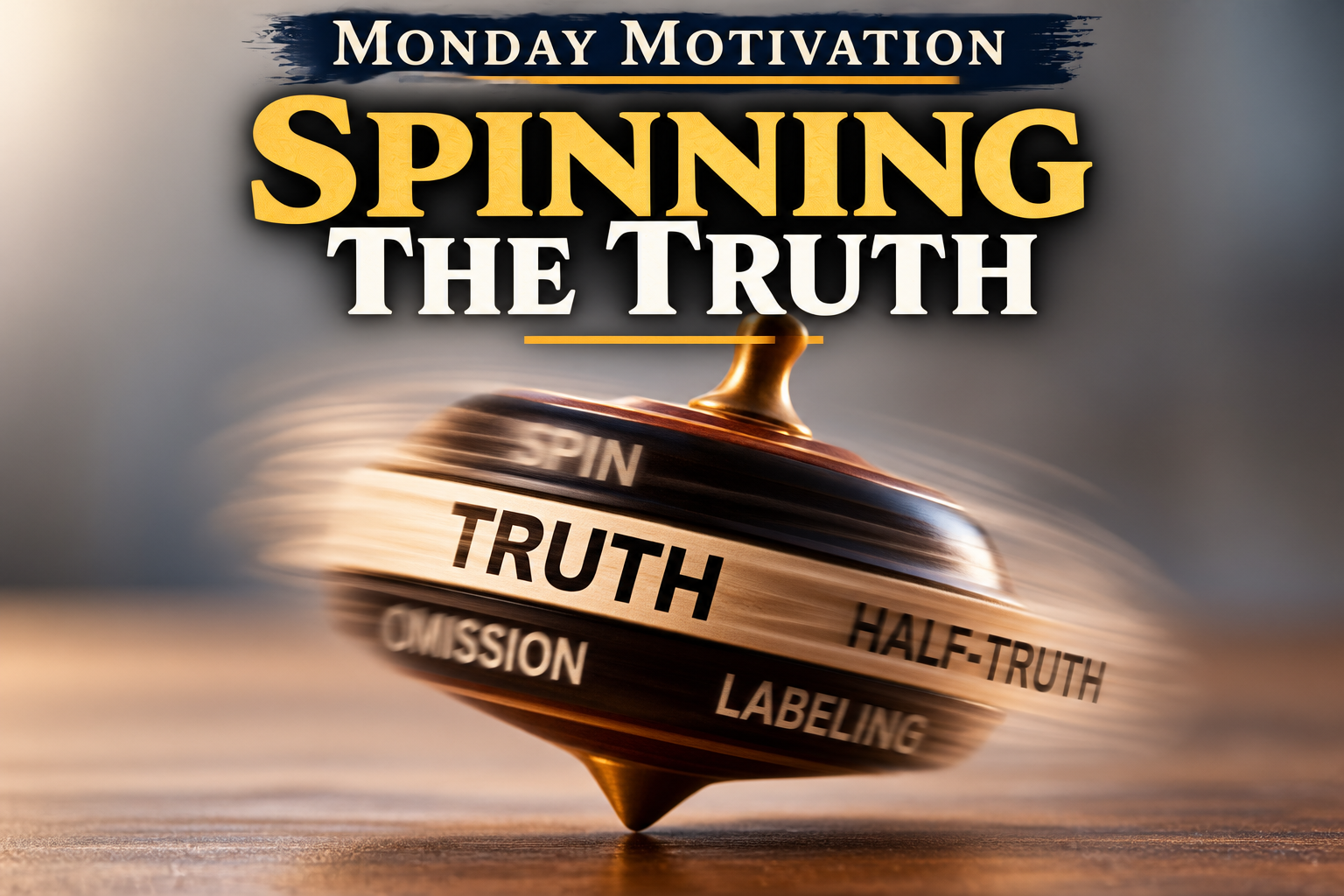
There are several common ways to spin the truth:
Spin by omission: Leave out the fact that would cause people to understand the situation differently.
Spin by certainty: Turn “we believe” into “we know.”
Spin by labeling: Call retreat “a victory,” danger “acceptable,” or failure “progress.”
Spinning the truth is not the same as telling the truth. It is hiding part of the truth in order to create the impression we want.
Jesus says the truth does not need spin. He gave a much simpler standard: “Let your ‘Yes’ be ‘Yes,’ and your ‘No,’ ‘No.’ (Matthew 5:37). There is something powerful about that kind of simplicity.
You do not need to spin the truth to protect your reputation. You need to build a reputation that can withstand the truth. Character is not built by how well we can spin the story. Character is built by being truthful, even when truth comes at a cost.
And once we begin lying, one lie rarely travels alone. It usually needs another lie to protect it, another explanation to support it, and another half-truth to keep people from looking too closely.
Ramses could carve his victory into stone. But carving it into stone did not change what happened at Kadesh. And spinning the truth does not change what happened in our lives either. It may protect our image for a while. It may temporarily persuade other people. It may even help us persuade ourselves that we are doing the right thing. But a carefully told story can never turn falsehood into truth.
So, tell the truth, the whole truth, even when it costs you something.
Why? Becausespin may protect your reputation for a season, but truth builds your character for a lifetime.
Ramses left behind monuments telling the world how he wanted to be remembered. But in the end, history looked beyond the monuments and asked what really happened.
Someday people may look beyond our version of the story too, and asked what really happened.
Don’t live a life that needs to be spun. Live a life that can withstand the truth.
–Dan Summerlin
Practical reflections for pastors and leaders who want to build healthier people, ministries, and organizations.
Explore all Articles →

Short, practical reflections every Monday to help leaders think clearly, lead faithfully, and live with character.
View all Monday Motivation →Invite Dan to speak, coach, or consult with your organization.
Contact Dan